For retailers, few mistakes are as costly—or as common—as mistaking weather for a seasonal trend. Increase replenishment orders for summer SKUs during an early April heatwave, and you end up discounting mountains of excess inventory by July. Cut holiday orders because a snowy December kept shoppers home, and you risk stockouts next Christmas.
To properly address this problem, retailers first need to understand why they keep falling into the same trap—and what operational steps will break the cycle.
A primary driver of this misstep is a failure to distinguish seasonal trends from short-term weather fluctuations.
What is the Difference Between Seasonality and Weather?
Seasonality refers to predictable, recurring demand spikes or troughs that repeat over fixed time intervals—such as calendar quarters, monthly cycles, and day-of-week trends. Driven by predictable, repeatable drivers like bank holidays, cultural events, traditions, calendars, and merchandising seasons provides the foundation for baseline demand forecasting.
Weather represents localized, short-term atmospheric variations; such as an unseasonable heatwave, an early cold snap, or severe rainfall. Weather is stochastic and pure meteorological forecasts provide the most reliable utility in the short term.
How Weather Distortion Affects Different Retail Planning Decisions
The implications of weather-driven demand vary depending on the retailer’s business model, product lifecycle, and ability to respond.
Replenishment-driven businesses: Responding to demand now
In grocery and many hardlines categories, weather can create immediate changes in purchasing behavior. Retailers need to anticipate these shifts to maintain availability and avoid unnecessary inventory. Weather-driven demand analytics can help retailers adjust near-term forecasts, refine replenishment quantities, and position inventory where demand is most likely to occur. The goal is to respond to a genuine weather-driven opportunity without treating every temporary spike as a permanent change in demand.
Fashion retailers: Planning for the next season
Fashion retailers face a different challenge because many assortment and buying decisions must be made well before products reach stores. Historical sales performance plays a critical role in determining which products to carry, how much inventory to buy, and how to allocate investment across categories and styles.
Consider a spring season with unusually cold temperatures. Demand for warm-weather apparel may fall below expectations, not because consumers no longer want those products, but because the weather has delayed purchasing. If merchants evaluate the season without accounting for that impact, they may reduce the following year’s buy quantities or shift their assortment away from products that would perform well under more typical conditions.
For fashion retailers, understanding weather-driven demand is therefore not just about reacting to current conditions. It is about interpreting historical performance correctly so that future assortment, financial plans, and inventory commitments reflect underlying consumer demand rather than the weather anomalies of a single season.
Why Retailers Mistake Seasonality and Weather?
The confusion rarely comes from a lack of effort; it stems from flawed metrics, psychological biases, and rigid systems.
- Using the Calendar: Retail Spring begins in February (the peak of meteorological winter) and Retail Fall begins in August (often the hottest month of the year). While there are merchandising reasons to place seasonal inventory on store shelves, for most consumers, the purchasing of these items takes place at the time of ‘need’, with weather being the largest influencing factor influencing demand.
- Linear Data Traps: Most inventory algorithms look at simple week-over-week or year-over-year sales variations without checking the weather context. A 30% increase in sales during week 16 might be interpreted as accelerating demand, triggering replenishment orders or higher inventory targets. But if the increase resulted from an unusually warm week, extrapolating that performance could create excess inventory when temperatures return to normal.
- Recency Bias: Merchants and planners naturally respond to recent performance. An unusually warm spring week can create pressure to increase summer buys, while a cold stretch can raise concerns about the season’s outlook. ‘Chasing the Weather’ is a common mistake when merchants are unable to separate the signal from the noise.
- Aggregated Historical Reporting: Looking at monthly or quarterly sales totals washes out short-term weather anomalies. A bad storm that destroyed foot traffic for three days gets buried in the monthly report, making the whole season look artificially weak.
4 Ways Retailers Can Avoid the Trap of Mixing Seasonality and Weather
Preventing these costly missteps requires blending better data habits with flexible supply chain operations.
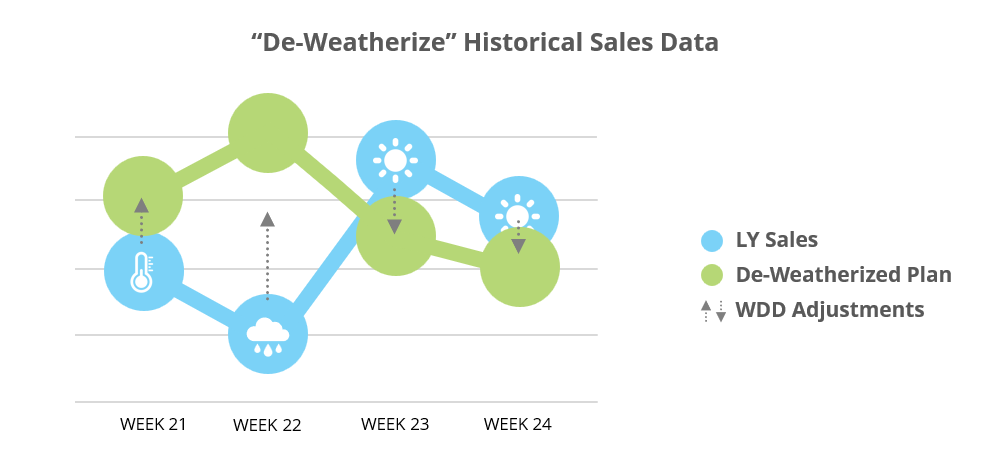
- “De-Weatherize” Historical Sales Data: Before building next year’s seasonal baseline, normalize past sales against historical weather indices. Weather-driven demand (WDD) is a metric that quantifies the specific impact of weather on performance. Businesses can utilize these WDD’s at the appropriate product, time, and location combination to strip out artificial spikes caused by anomalous weather so core baseline models reflect true underlying demand.
- Utilize Weather-Driven Demand Sensing Systems: Replace rigid, static reorder rules with near-term WDD outlooks. Use WDD metrics as a short-term demand sensing tool to adjust replenishment systems and related calculations.
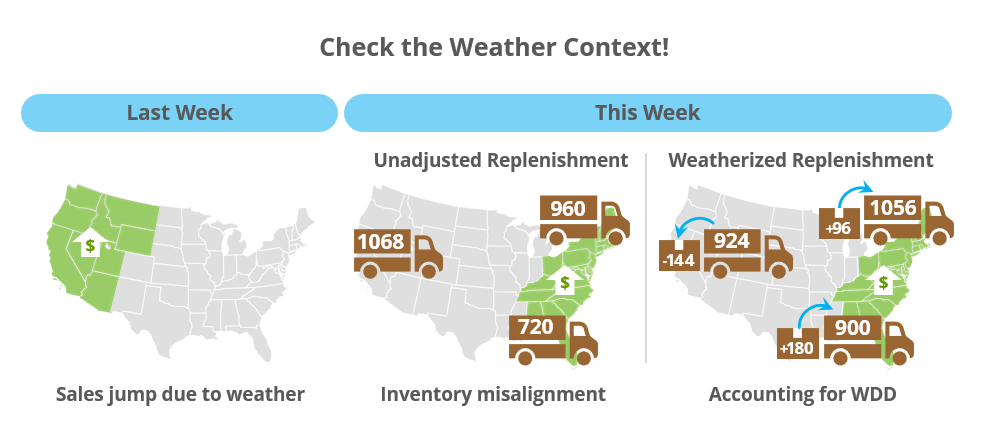
- Decouple Procurement from Local Replenishment: When possible, hold a portion of inventory in central distribution centers rather than pushing it all to stores. This enables retailers to route inventory dynamically to regions in advance of favorable weather, ensuring weather-driven demand opportunities are utilized appropriately.
- Establish Post-Event Debriefs: Audit sales regularly to account for demand spikes and troughs. Determine if results were driven by a marketing promotion, a seasonal shift, or a weather anomaly before updating long-term inventory plans.
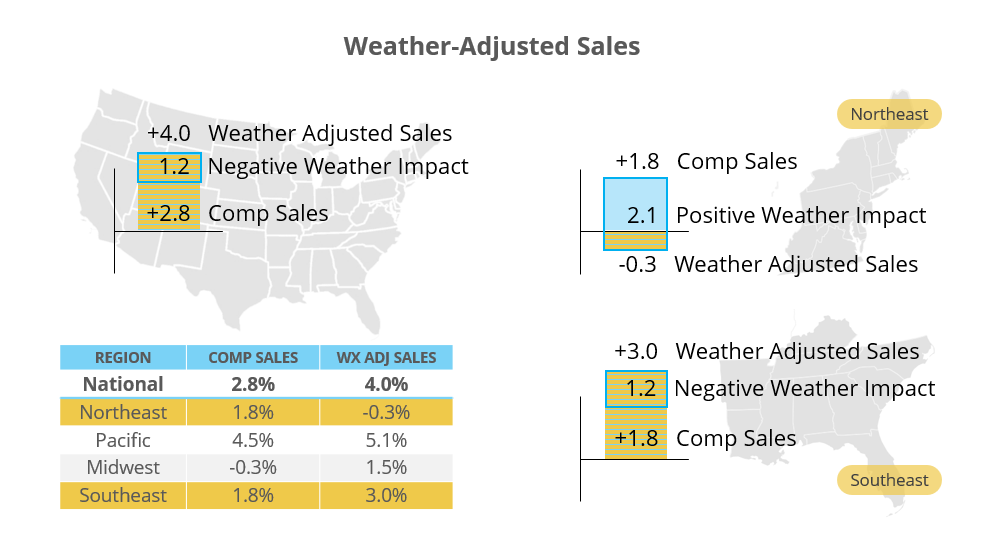
Retailers have many levers they can control; product, pricing, assortment, promotions, and more. Weather, however, remains the single largest external factor influencing consumer purchasing decisions.
While retailers cannot control the weather, they can better understand and anticipate its impact on demand.
By separating long-term seasonal rhythms from short-term weather-driven demand, retailers can leverage predictive demand analytics to proactively assess these impacts across products, time periods, and locations. Integrating the science of weather-driven demand analytics into forecasting, replenishment, inventory planning, and other business processes allows retailers to better prepare for changes in demand rather than react to unexpected spikes or troughs.
The result is better alignment between inventory and actual demand; helping protect margins, reduce stockouts and excess inventory, and improve customer satisfaction.
About Planalytics
Planalytics is the global leader in Weather-Driven Demand® (WDD) analytics. Planalytics translates complex meteorological data into actionable business metrics. Leading retailers and brands leverage WDD to optimize inventory and align digital marketing with localized demand patterns. Planalytics’ clients consistently realize substantial returns, including increased sales, enhanced profitability, and significantly improved digital campaign effectiveness.
About RetSci
RetSci is a retail science and analytics company focused on making advanced analytics and data science practical, accessible, and impactful for retailers and wholesalers. Leveraging decades of recognized expertise in retail science, industry domain knowledge, and advanced technologies, RetSci tailors innovative planning and analytics solutions to meet the unique business needs of each client. From descriptive analytics that explain what happened, to predictive models that forecast what’s next, to prescriptive solutions that guide action, RetSci helps clients unlock the full potential of their solutions and simplify the process of turning data into decisions. Learn more at: https://www.retsci.com.